July 30, 2026
The Science Behind Turnaround Time
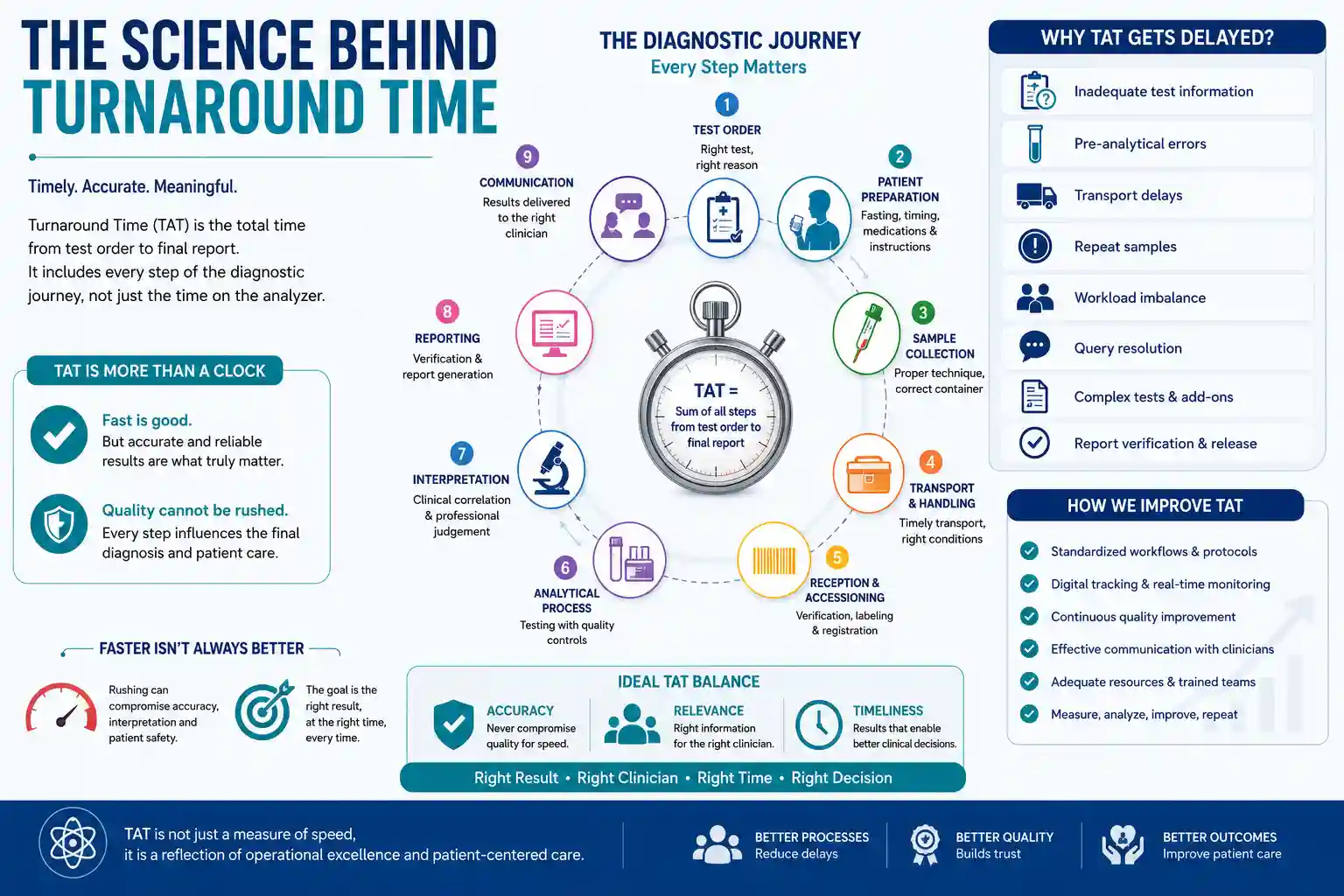
Turnaround Time (TAT) is one of the most closely watched performance indicators in every diagnostic laboratory. Clinicians expect rapid reports, patients anxiously await results, and hospital administrators often use TAT as a benchmark of laboratory efficiency. At first glance, it appears to be a simple metric — the time taken from receiving a specimen to issuing the final report. In reality, turnaround time is far more complex. It begins the moment a test is ordered and encompasses every stage of the diagnostic pathway, including patient preparation, specimen collection, transportation, accessioning, analytical testing, interpretation, reporting, and communication of results. A delay at any one of these stages can affect the overall TAT, regardless of how efficient the analytical process may be.
Advances such as laboratory automation, barcode tracking, digital pathology, pneumatic tube systems, and artificial intelligence have undoubtedly accelerated many laboratory workflows, but technology alone cannot guarantee meaningful improvements if the surrounding processes remain inefficient. Measuring TAT without understanding its individual components is much like measuring the total duration of a journey without identifying where the traffic actually occurred.
Why Faster Is Not Always Better
One of the most common misconceptions in healthcare is that the fastest laboratory is automatically the best laboratory. While timely reporting is undoubtedly important, speed should never come at the expense of accuracy, quality, or patient safety. A pathology report issued in record time is of little value if the specimen was inadequately fixed, the clinical history was incomplete, additional immunohistochemistry was omitted, or a critical finding was overlooked.
Complex biopsies, molecular diagnostics, microbiological cultures, and multidisciplinary consultations naturally require longer processing times because they involve additional scientific evaluation rather than unnecessary delays. Equally important are the pre-analytical and post-analytical phases, which together account for a substantial proportion of the total turnaround time. Delayed specimen transport, incomplete requisition forms, mislabeled samples, repeat collections, clinician queries, and report verification often contribute more to prolonged TAT than the analytical process itself. Therefore, meaningful turnaround time should not be viewed simply as a race against the clock but as the delivery of the right diagnosis to the right clinician at the right time, with complete confidence in its accuracy.
Improving Processes, Not Just Pace
Throughout my career in laboratory medicine, I have found that laboratories consistently achieving excellent turnaround times share one characteristic — they focus on improving processes rather than merely accelerating individual tasks. Standardised workflows, clearly defined quality indicators, effective communication between clinicians and laboratory teams, regular monitoring of bottlenecks, digital specimen tracking, adequate staffing, and continuous quality improvement initiatives contribute far more to sustainable performance than asking staff to work faster.
Every laboratory should establish clinically relevant TAT targets based on the urgency and complexity of individual investigations rather than adopting a one-size-fits-all approach. Routine biochemistry, emergency haematology, histopathology, molecular diagnostics, and microbiology each have distinct scientific requirements and therefore deserve different performance benchmarks.
Ultimately, turnaround time is not simply a measure of laboratory speed — it is a reflection of operational excellence, process reliability, interdisciplinary collaboration, and patient-centred care. The true goal of every diagnostic laboratory should not be to produce the quickest report, but to deliver the right result, to the right clinician, at the right time, enabling the right clinical decision — because in healthcare, timely and accurate diagnostics together have the greatest impact on patient outcomes.